 管理
管理
管理工作组: Patient Administration  | 标准状态: Informative |
FHIR管理组件由一系列基础资源构成,这些基础资源包含了医疗场景中的各类主数据。在临床、运营、工作流等场景中FHIR的其它组件将引用这些基础资源。
它是建立在FHIR基础框架(技术平台)组件(第一级和第二级组件)之上的。
完整的临床数据资源的记录先后顺序是:首先记录患者的基本信息,然后记录就诊信息(如门诊记录),最后才记录临床数据,并通过引用包含主数据的基础资源形成临床数据资源。
跟踪接受医疗服务的患者,几乎所有其它资源都需要引用它包含的主数据信息。
| 资源名称 | 其它叫法 | 描述 |
| Patient | SubjectOfCare Client Resident | Demographics and other administrative information about an individual or animal receiving care or other health-related services. |
| RelatedPerson | Information about a person that is involved in the care for a patient, but who is not the target of healthcare, nor has a formal responsibility in the care process. | |
| Person | Demographics and administrative information about a person independent of a specific health-related context. | |
| Group | Represents a defined collection of entities that may be discussed or acted upon collectively but which are not expected to act collectively, and are not formally or legally recognized; i.e. a collection of entities that isn't an Organization. |
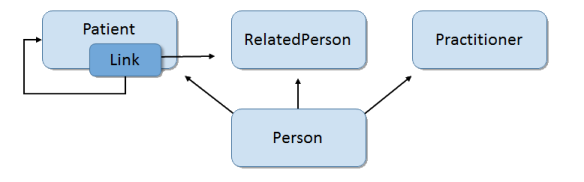
Implementation Note: Patient linking should also be considered when evaluating searches with references to other resources. e.g. searching for a patients' conditions for a patient.
At present the specification does not define if the links should be also followed to include conditions that reference the linked patients too. We are currently seeking feedback on this.
Implementation Note: The Person resource may be used as a centralized register of people that may eventually be involved in healthcare, and could be used as the central core demographics register.
However, the fields/values in Person are duplicated in the other resources, and in many cases the Person resource will be hosted on external systems.
大多数临床活动都以某种分组方式组合在一起。长期治疗(如:慢病、门特、心理、肿瘤等)通常使用EpisodeOfCare资源,而短期治疗则使用Encounter资源。Account资源将就诊交易记录与Patient资源和其他相关资源关联起来。Flag资源仅用于突出显示和患者资源(或其他资源)相关的警告或其他通知。
| 资源名称 | 其它叫法 | 描述 |
| EpisodeOfCare | 病例、 治疗项目、病症 | An association between a patient and an organization / healthcare provider(s) during which time encounters may occur. The managing organization assumes a level of responsibility for the patient during this time. |
| Encounter | 访视、医患接触 | An interaction between a patient and healthcare provider(s) for the purpose of providing healthcare service(s) or assessing the health status of a patient. |
| Account | 费用中心 | A financial tool for tracking value accrued for a particular purpose. In the healthcare field, used to track charges for a patient, cost centers, etc. |
| Flag | 照护围栏, 警示 | Prospective warnings of potential issues when providing care to the patient. |
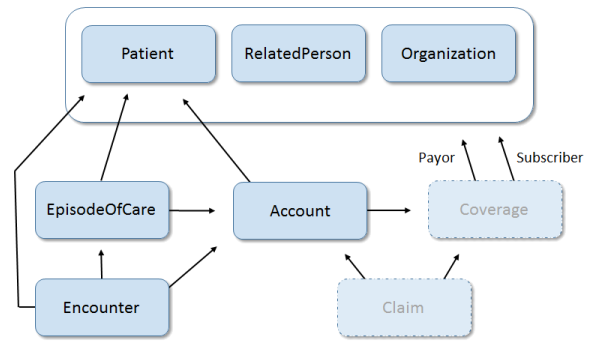
Implementation Note: Resources shown with a dotted box are described in other sections of the specification:
CoverageandClaimare from the section on Finance.
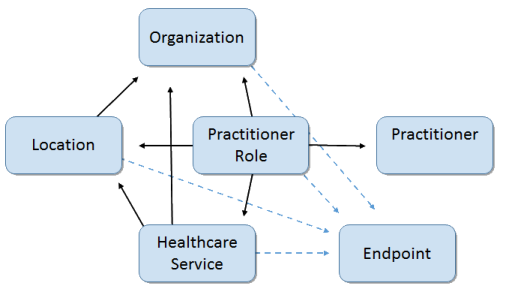
服务目录类资源通常存储在应用软件的管理后台,甚至可以从外部系统同步。
| 资源名称 | 描述 | |
| Organization | A formally or informally recognized grouping of people or organizations formed for the purpose of achieving some form of collective action. Includes companies, institutions, corporations, departments, community groups, healthcare practice groups, payer/insurer, etc. | |
| Location | Details and position information for a physical place where services are provided and resources and participants may be stored, found, contained, or accommodated. | |
| Practitioner | A person who is directly or indirectly involved in the provisioning of healthcare. | |
| PractitionerRole | A specific set of Roles/Locations/specialties/services that a practitioner may perform at an organization for a period of time. | |
| HealthcareService | The details of a healthcare service available at a location. | |
| Endpoint | The technical details of an endpoint that can be used for electronic services, such as for web services providing XDS.b or a REST endpoint for another FHIR server. This may include any security context information. |
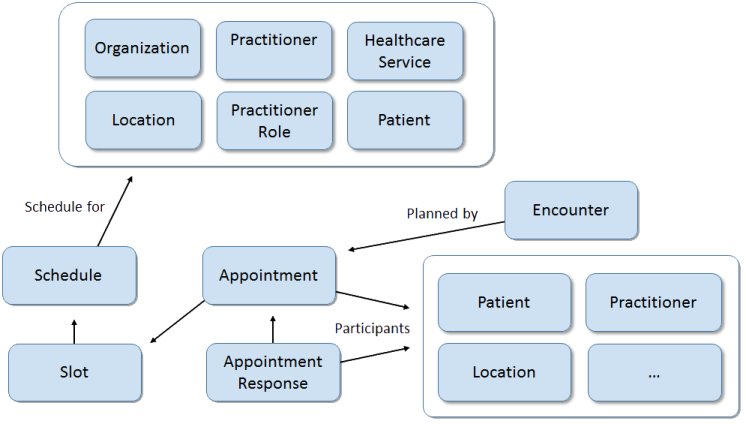
预约安排类资源用于规划医疗活动的时间,并协调相关临床活动的顺序。
| 资源名称 | 其它叫法 | 描述 |
| Schedule | 可用性、班次 | A container for slots of time that may be available for booking appointments. |
| Slot | 号源时段 | A slot of time on a schedule that may be available for booking appointments. |
| Appointment | 预约、号源 | A booking of a healthcare event among patient(s), practitioner(s), related person(s) and/or device(s) for a specific date/time. This may result in one or more Encounter(s). |
| AppointmentResponse | 预约确认A reply to an appointment request for a patient and/or practitioner(s), such as a confirmation or rejection. |
其他资源通常注册在基础资源管理系统中,并作为主数据进行维护。
| 资源名称 | 其它叫法 | 描述 |
| Device | A type of a manufactured item that is used in the provision of healthcare without being substantially changed through that activity. The device may be a medical or non-medical device. | |
| DeviceDefinition | The characteristics, operational status and capabilities of a medical-related component of a medical device. | |
| DeviceMetric | Describes a measurement, calculation or setting capability of a medical device. | |
| Substance | A homogeneous material with a definite composition. |
Patient privacy is handled with security labels and tags in the Resource Meta property. This is the standard way in which that the FHIR specification provides this supporting information to a sub-system that implements it (which is not defined by FHIR).
One of the more common use cases is for marking a patient as being a celebrity.
Note that privacy considerations apply to Person, Practitioner and RelatedPerson records in addition to Patient's.
While Organization, Location, Device and other non-person-identifying records are generally subject to less stringent security precautions, such data must still be protected to avoid safety issues (e.g. someone maliciously changing the ingredients associated with a drug to cause/fail to cause alerts)
Devices can be linked to Patients. If this occurs, they must be protected as any other patient-linked element
For more general considerations, see the Security and Privacy module.
Administration Resources are cornerstone resources that are used by clinical and other domains of the FHIR Standard.
The Patient Administration is currently working through resources that support:
Many of the administrative resources are part of the core resources that most systems
use first and have formed the basis for most people's first experiences with FHIR.
However this limited exposure has still to be proven in all contexts, such as veterinary, public health and clinical research.